Playdough, The Scientific Method and Raw Material Substitutions
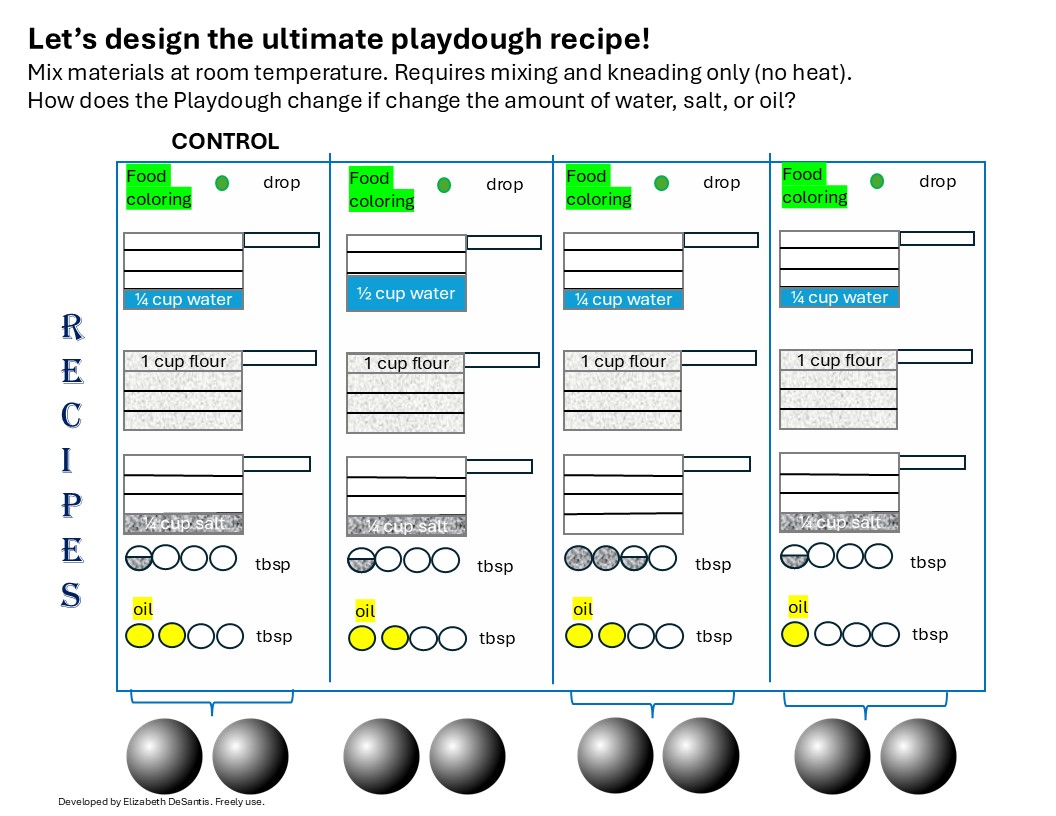
Today, we are going to use Playdough recipes to understand the impact of ingredients on recipe performance. If you are working with a young child, just follow the experimental plan in the image above. I drew the recipe out to encourage better math skills.
Let’s use Playdough recipes to learn how scientists approach problems using the scientific method.
Motivations
Let’s imagine our company has three opportunities to make money:
- We can no longer use All Purpose Flour. We need to find a combination of substitute ingredients and their ratios to make Playdough that performs the same or better.
- Make a Playdough that can be stretched farther without breaking.
- Make a Playdough that costs less; if it is possible to make shapes out of it, you have succeeded.
Let’s take care and approach this scientifically
Materials chemists develop new materials in the lab, which are scaled up and used for various applications. After the formula is developed, we may need to change ingredients for various reasons, but swapping out ingredients might cause a lot of problems. In 2026, I helped to preserve $750k annually in sales by preserving product performance on one project in which we successfully replaced an ingredient that was being discontinued, which is more than double the mean cost of a house in Cincinnati in 2026. Recent disappointment in Hershey’s Reese’s branded products demonstrates the risk in changing formulations for cost or other reasons.
Doran, Brady. “The Hershey Company responds to Reese’s family member’s complaint about Reese’s peanut butter cup recipe.” https://www.abc27.com/hershey/the-hershey-company-responds-to-allegations-over-reeses-ingredient-changes/. Accessed 10-23-26.
Deutsch, Jonathan. “Controversy over Reese’s ingredients reveals standard food industry practices most consumers never notice.” https://www.yahoo.com/lifestyle/articles/controversy-over-reese-ingredients-reveals-123222373.html. Accessed 10-23-26.
Swapping out raw ingredients requires understanding the impact on performance. Let’s approach these opportunities systematically, like scientists do.
Scientific method
- Make observations
- Ask a question
- Conduct background research
- Form a hypothesis
- Make a prediction
- Analyze data and draw conclusions
- Iterate and share results
Make observations & ask a question
First, let’s observe what happens when we try to decrease the cost of Playdough by reducing the amounts of various ingredients. Note that water costs less than any other ingredient, so increasing the amount of water lowers the cost, too. Use All Purpose Flour.
Observations

- When I decrease oil, the Playdough gets _____
- When I increase water, the Playdough gets ____
- When I decrease salt, the Playdough gets ____
When I do these experiment, I find that all of these changes negatively impact performance, so they aren’t acceptable changes to make.
Conduct background research
Let’s start by reading what ingredients do within the Playdough recipe, and making hypotheses about how potential changes will impact the recipe. We can use the internet to understand how various ingredients impact the recipe, and why. Here are a few articles to get you started:
- Ward, Jason. “The Chemistry Of Playdough.” https://teachersinstitute.yale.edu/curriculum/units/2020/2/20.02.05/2. Accessed 10-23-26.
- The Serious Eats Team. “What is Gluten? The science behind really great dough.” https://www.seriouseats.com/what-is-gluten-free-bread-dough-pasta. Accessed 10-23-26.
- Rossi Anastopoulo. “A beginner’s guide to gluten.” https://www.kingarthurbaking.com/blog/2021/08/18/a-beginners-guide-to-gluten. Accessed 10-23-26.
Make Hypotheses:
Based on our research, we can make many hypotheses about these ingredients in Playdough: dough, salt, oil, water. A common misunderstanding that is that hypotheses are “just guesses”. As you can see, we did a lot of reading to make these “educated guesses.”
- Gluten development makes playdough both stretchable prior to breaking and resistant to being squished.
- Salt increases the toughness and decrease the stickiness of Playdough by interacting with strands of the protein that become gluten.
- Oil makes playdough less stretchy before it breaks, but also less sticky.
Do you notice how all of these hypotheses are testable? Hypotheses are educated, testable guesses.
Make a prediction.
Here is some additional research to look at before making predictions:
- MonoAdmin. “The chemistry of salts: A beginner’s guide to understanding their properties and uses.” https://pluschem.com/blog/the-chemistry-of-salts/. Accessed 10-23-26.
- Back Your Yard Staff Member. “A Comprehensive Guide to Ice Melt: Understanding Sodium Chloride, Magnesium Chloride, and Calcium Chloride”. https://www.backyouryard.com/post/guide-to-ice-melt. Accessed 10-23-26.
- SODIMATE: Advanced Environmental Solutions. “Sodium Chloride vs. Potassium Chloride: Which is better for Water Softening?” https://sodimate-inc.com/sodium-chloride-vs-potassium-chloride-which-is-better-for-water-softening/. Accessed 10-23-26.
Here are some predictions:
- Cake flour and all-purpose flour will perform differently. Cake flour will make the playdough have less gluten. Cake flour playdough will be both less stretchable prior to breaking and less resistant to being squished. Bread flour has more proteins that make gluten, so it will make bread more stretchable prior to breaking and more resistant to being squished.
- Salt food substitutes (using potassium chloride) are less effective than salt substitutes using sodium chloride. Road salt substitutes (like calcium chloride) will give off heat when making the Playdough, making it unsafe to handle using our current practices.
- Oil. The cheapest oil will work just as well as the most expensive oil.
Based on these predictions, I came up with some initial priorities for myself:
- We should not change salt type or amount. Other salts are more expensive and/or potentially unsafe to use.
- Stick with vegetable oil, which is cheap and readily available.
- Let’s combine bread flour and oil in the standard recipe to start, and see what happens.
Hope this helped you get started. Did any of your initial Playdough recipes you design match the company opportunities? Designing recipes is actually a lenghty process. If you liked trying this, consider a career in chemsistry!